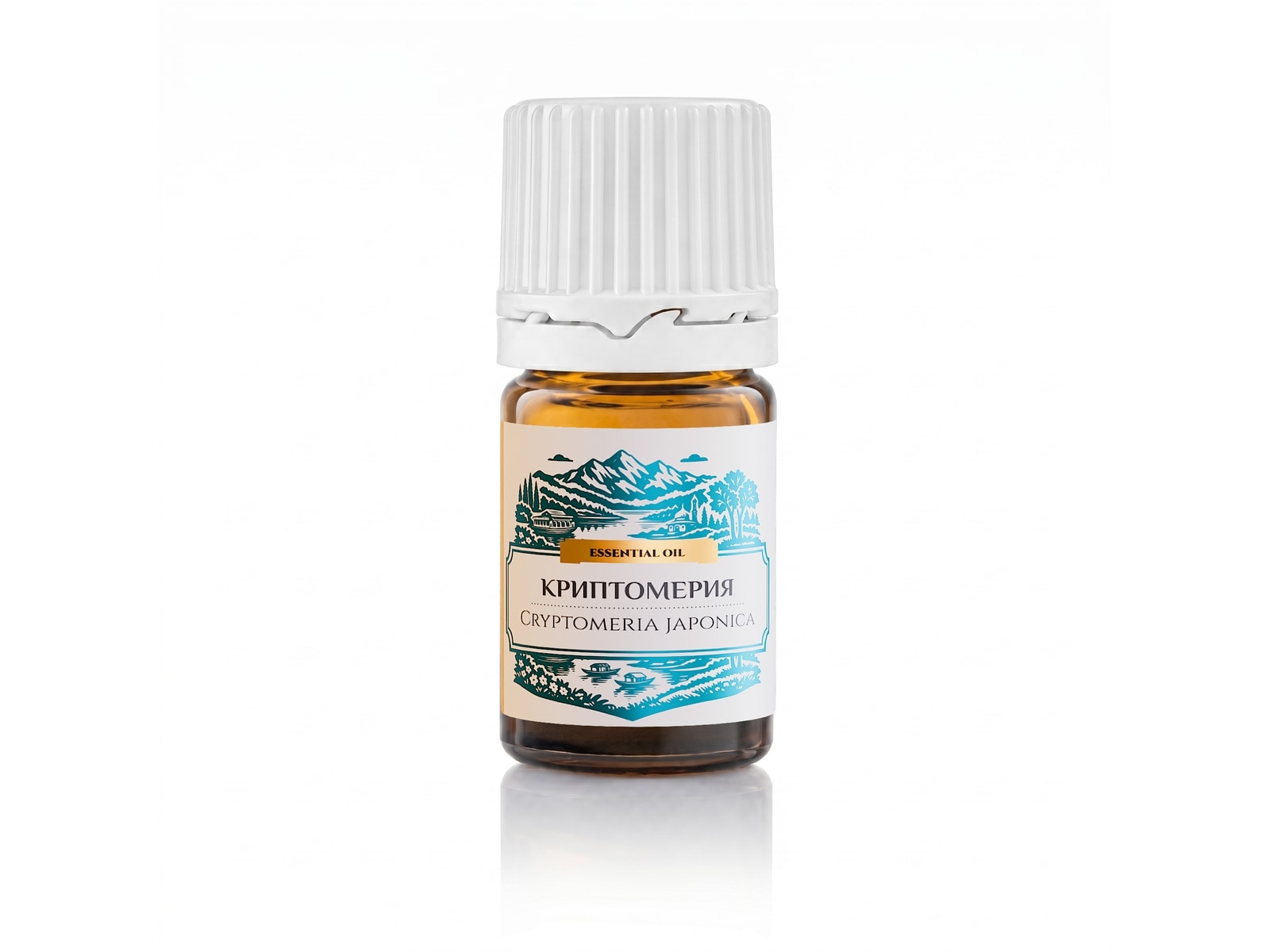

Cryptomeria: mental exertion and a restorative forest atmosphere
Japanese cedar provides a complex woody-coniferous aroma. It is chosen for calming transitions after monotonous work, reading, or prolonged concentration. A green freshness gradually reveals deeper resinous notes.
Stress response: what was studied
In the initial study, participants performed a computational task in a room with the aroma of wood essential oil of cryptomeria and without it. Researchers measured salivary markers and subjective ratings. During aromatic exposure, changes in DHEA-s secretion — a hormonal marker linked to the physiological response to load — were observed. [1]
In this study, a short-term physiological response to the aroma of wood essential oil of cryptomeria after mental load was evaluated. Wood oil and conifer oil differ in composition and aromatic character.
Emotional unloading
In aromatherapy, cryptomeria is suitable for feeling space and calm focus. It can be assessed on a separate strip during a short pause, without saturating the entire room. Mandarin softens the forest accord, lavender makes it calmer, and cypress makes it drier.
Wood composition for relaxation
Sandalwood extends a smooth warm base, vetiver adds root-like depth. This blend is appealing to those who dislike sweet evening fragrances. For developing an external formula, it is first essential to know the plant part and specific application recommendations for this material.
Cryptomeria is a distinct conifer. Its aroma differs both from Siberian pine and from wood oils of the genus Cedrus: choose it for its own forest character and blends that bring out this particular note.
Blending suggestions
Mandarin softens the woody freshness, lavender adds a calm herbal heart. Cypress emphasizes dryness, sandalwood and vetiver extend the woody base.
Research in detail
Wood aroma after mental load
Participants performed a computational task in a room with the aroma of Japanese cedar essential oil and without it. Researchers evaluated the perception of the environment and salivary markers; aromatization led to changes in DHEA-s secretion. The study focuses on the response to a woody oil, whose composition differs from that of needle oil. [1]
How to use
Examples for adults. Quantities are given for the entire bottle; for one application, take a small portion of the mixture. These are aromatic therapy routines, not medicinal dosages.
- Getting acquainted with the scent: apply a sample to a perfumery blotter according to the product instructions. Evaluate the aroma at a comfortable distance, without touching the oil to your skin. For comparison of combinations, use a separate strip with a partner's fragrance; remove both samples if discomfort occurs.
Precautions
Dilute in a carrier oil before applying to skin. Do not ingest or apply to mucous membranes; stop use if irritation occurs. Store tightly closed, away from heat and light: oxidised oil is more likely to cause skin reactions.
What to combine with this care
- “Provence” lavender essential oil — Aromatic combination
- Mandarin essential oil — Aromatic combination
- White sandalwood essential oil BIO — Aromatic combination